

Most Australians hold some form of life insurance, but many haven't looked at it in years. The latest data shows insurers pay the vast majority of claims. The bigger risk is having the wrong amount of cover, or cover you think you have but don't.
Do insurers actually pay claims?
Yes, in the large majority of cases. Every six months the Australian Prudential Regulation Authority (APRA) publishes how many claims each type of cover accepts. The latest release covers the 12 months to 31 December 2025, across 13 life insurers.
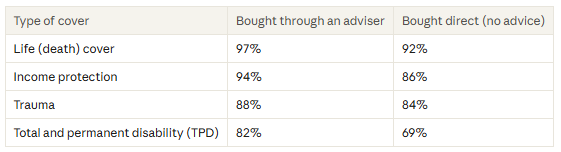
Source: APRA Life Insurance Claims and Disputes Statistics, 12 months to 31 December 2025, as reported by Insurance Business. Rates are the share of finalised claims that were accepted.
Claims paid through an adviser are accepted more often for every type of cover in the table. APRA has previously suggested why: advisers help clients understand what their policy covers before they apply, and before they claim.
Claims are also paid fairly quickly. Across all channels, 76% of death claims and 56% of trauma claims were finalised within two weeks. TPD takes longest, averaging 3.8 months, because the insurer must assess whether someone can return to work.
You don't have to die for insurance to pay
Most claims are paid to people who are still alive, recovering from illness or injury. TAL, Australia's largest life insurer, paid about $4.7 billion to 57,000 customers between 1 April 2025 and 31 March 2026. Three in four of those claims were for "living" cover: income protection, TPD and trauma. (TAL)
The most common reasons people claim may surprise you:
Mental health has been TAL's leading cause of claims for five years running, at 22% of claims, ahead of cancer (17%) and injuries (14%). (Insurance News)
Across the industry, mental health now drives almost one in three TPD claims and one in five income protection claims. Insurers paid more than $2.2 billion in mental health claims in 2024, almost double five years earlier. (Insurance Business)
For trauma cover, cancer is the biggest cause. At one insurer, Resolution Life, cancer made up about 65% of trauma claims, and heart attack, stroke and other circulatory conditions about 21%. (Arrow Equities)
The average trauma claimant at AIA Australia is 53, so this isn't only a concern for older Australians. (Skye Wealth)
Are Australians underinsured?
Many are, and more people are starting to realise it.
In NobleOak's April 2025 survey, 23% of people with life insurance believed they had less cover than they need, up from 18% a year earlier. (NobleOak)
The gap was wider for people who rely on cover through their super: 27% believed they were underinsured, compared with 18.5% through other channels. (NobleOak)
Older but still widely cited research from Rice Warner (2015) found median life cover met only 61% of a family's basic needs. Median TPD and income protection cover met just 13% and 16% of needs. (Rice Warner)
Business owners: if your business relies on you or one or two key people, key person insurance can fund the business through their loss. One survey of small businesses found 20% were worried about losing a key person, but only 2% had key person cover. (Kelly Partners)
Cover that was right a few years ago may not be enough now
Many people set their cover once and never revisit it. Since then, a lot has changed:
Interest rates are up. On 29 September 2026 the Reserve Bank lifted the cash rate to 4.6%, a 15-year high. It was the fourth rise this year and leaves rates a full percentage point higher than in January. (Capital Brief, Savings.com.au) If your cover was meant to clear the mortgage or keep up repayments, it may now fall short.
Living costs are higher. The amount your family would need each year to keep their lifestyle has likely grown.
Cover in super is getting more expensive. AustralianSuper, for example, lifted premiums from 30 May 2026: TPD by an average of 40%, death cover by 20% and income protection by up to 38%. (Insurance Business) Rising premiums quietly eat into your super balance, and some people cut their cover without realising what they've given up.
Your life has changed. A new home, a new baby, a new business or a pay rise can all change how much cover you need.
Real stories from our clients
Names and details have been changed to protect our clients' privacy.
Time to recover after a stroke
One of our clients recently had a stroke. Because he held trauma cover, he received a lump sum payment after his diagnosis. That money gave him the financial breathing room to take the time off work he needed to recover, without worrying about the bills.
Trauma cover pays a lump sum when you're diagnosed with a listed condition, such as a stroke or cancer that meets the policy's definition. It doesn't depend on whether you can work, and you can use the money however you need. Income protection is different: it replaces part of your income while you can't work. Many people benefit from having both.
A policy that was never meant to be cancelled
Kyle, one of our advisers, met a client who had just been diagnosed with a terminal illness. The client's insurer told him his policy had been cancelled for missed premium payments.
Kyle dug into the history and found the policy should not have been cancelled. After a lot of back and forth with the insurer on the client's behalf, the policy was confirmed as in force. The client's trauma claim was paid, and his family will also be able to claim on his life insurance.
This outcome isn't the norm. Usually, if premiums stop, cover stops. The lesson is simple: don't assume you're covered. Check that your policies are active, your payment details are current, and someone in your corner knows what you hold.
Book your 5-minute insurance check
It takes about five minutes and a few questions for us to check you're covered for when things go wrong. We'll confirm your policies are in force, whether your cover still matches your mortgage, family and lifestyle, and whether what you hold in super is still good value.
Book a quick insurance check-up
Prefer to talk? Call us on 9545 0054 or email info@shirefinancial.com.
General advice warning: This article contains general information only and does not take into account your objectives, financial situation or needs. Before acting on it, consider whether it is appropriate for you and read the relevant Product Disclosure Statement. Claim outcomes depend on each policy's terms and definitions. Ryan Walker (AR 349955) and Shire Financial Planning Pty Ltd (CAR 415618) are authorised representatives of Lifespan Financial Planning Pty Ltd (AFSL 229892).